

The 2026 Honda Passport and 2026 Honda Pilot share so much hardware that they can look difficult to separate on a spec sheet. Both use Honda’s 3.5-liter V6 producing 285 horsepower and 262 lb-ft of torque, paired with a 10-speed automatic transmission. Both use Honda’s second-generation i-VTM4 all-wheel-drive system when AWD is fitted. Both can tow up to 5,000 pounds.
Fuel economy does not create much distance between them, either. In like-for-like AWD form, most trims return the same EPA rating of 19 mpg city, 25 mpg highway, and 21 mpg combined, while the TrailSport versions drop to 18 mpg city, 23 mpg highway, and 20 mpg combined. In other words, there is no meaningful fuel-economy argument to be made for either vehicle when equivalent trims are compared.
Yet they are aimed at different buyers, and the gaps between them are larger than the shared parts list suggests. Here are the five that matter.
Related: Honda Passport 2025 vs 2026: Is the New Model Worth the Extra Cost?
1. The Pilot Has A Third Row; The Passport Doesn’t
The Pilot seats eight on every trim except the TrailSport, which seats seven. The Passport seats five across two rows. Pilot third-row legroom is 32.5 inches, headroom is 39.3 inches, and shoulder room is 59.5 inches. For context, that gives it more listed third-row legroom than a Jeep Grand Cherokee L and slightly more than a Kia Telluride, though the Telluride’s boxier rear body can make its third row feel more open in practice. Adults will not want to live back there on a six-hour drive, but the row is sized for genuine human use rather than emergency seating. That is still worth verifying in person, because access matters as much as the dimensions. Adults need a reasonable lean-and-slide to get back there; children will manage it with less negotiation.
Honda
View the 2 images of this gallery on the
original article
The cargo layout follows the seat count. Behind the Pilot’s third row, there is 18.6 cubic feet of space, enough for soft weekend luggage for a family of five, but not enough for a full load of road-trip gear without careful packing. Fold the third row and the figure climbs to 48.5 cubic feet, reaching between 87.0 and 113.7 cubic feet with the second row also down, depending on trim.
The Passport’s two-row layout starts with 44.0 cubic feet behind the second row and expands to 80.5 cubic feet with the rear seats folded. The Pilot carries more total volume by some margin. The Passport counters with a flatter, less interrupted cargo area because there is no folded third-row seatback in the way. That is a real-world advantage when you are sliding in a bike, camping gear, or flat-pack furniture.
Verdict: If you regularly carry six or more people, the Pilot is the obvious answer in Honda’s SUV lineup. If you do not, the Passport’s two-row layout is more useful for nearly everything that is not another row of passengers.
Related: As a Parent, I Fell Hard for the 2026 Honda Pilot Elite AWD. Here’s Why.
2. The Cheaper Passport Has Better Off-Road Geometry Than The Pricier Pilot TrailSport
The base Passport RTL, on standard 18-inch all-season tires with no off-road equipment, has a departure angle of 27.1 degrees and an approach angle of 23.0 degrees. The Pilot TrailSport, with rugged-terrain tires, off-road-tuned suspension, skid plates, and trail-focused camera tech, manages 19.0 degrees of departure angle and 19.9 degrees of approach angle.
That means the Passport RTL beats the Pilot TrailSport by 8.1 degrees of departure angle and 3.1 degrees of approach angle, despite using ordinary road tires and costing less.
Honda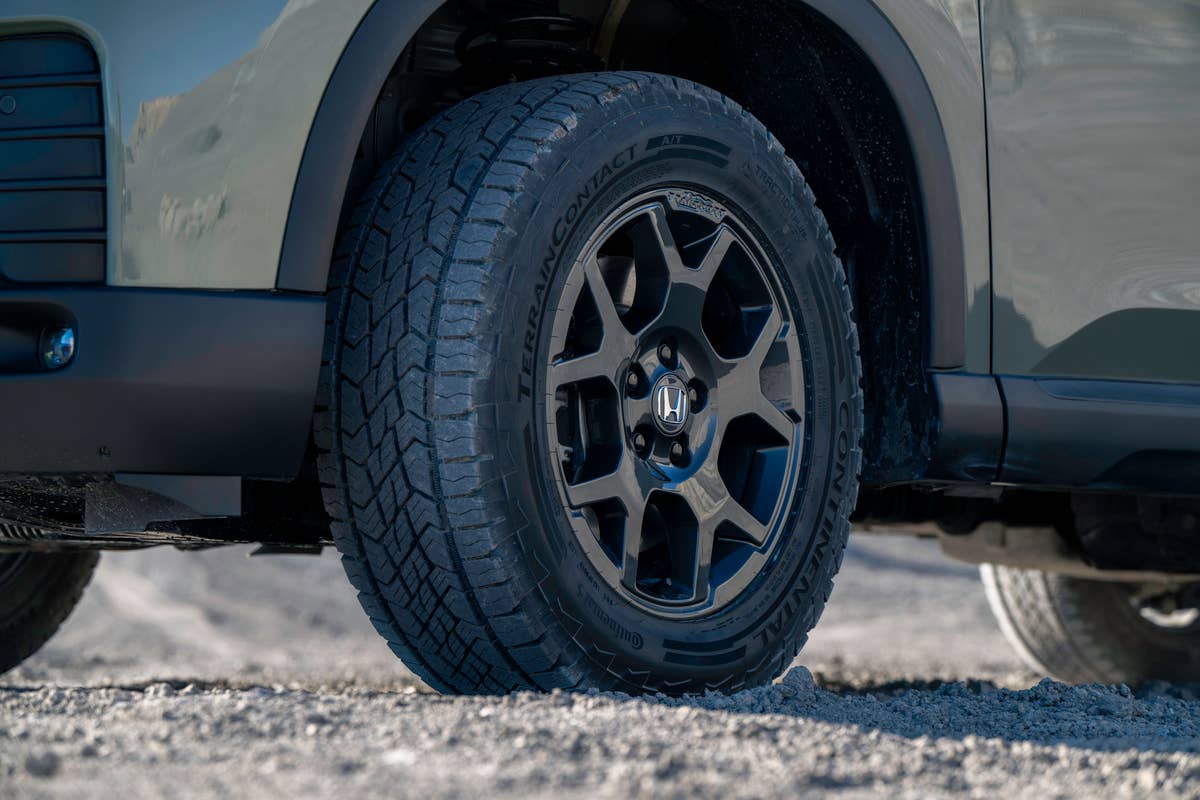
Ground clearance tells a similar story. The Passport sits at 8.3 inches across every trim. The Pilot sits at 7.3 inches in most configurations, with the AWD TrailSport rising to 8.3 inches. But the key difference is not only suspension height. It is body shape. The Pilot’s longer rear overhang, required to package the third row and rear cargo area, hurts its departure angle. The Passport’s shorter tail preserves it. No amount of suspension tuning or all-terrain rubber recovers what the geometry gives away at the factory.
That matters off-road in a more practical way than the numbers suggest. Departure angle dictates how steeply a vehicle can exit a ledge, climb-out, or rut without dragging its rear bumper. A vehicle with better departure geometry can simply clear obstacles that another one cannot, regardless of how rugged its tires look.
Verdict: If off-road geometry actually matters, the Passport RTL at $44,950 is more naturally capable than the Pilot TrailSport at $50,395. The Pilot TrailSport is meaningfully equipped for rough-road family use, but its three-row body prevents it from matching the Passport’s basic trail geometry.
Related: The 2026 Honda Pilot Has Many Trims, but Only One Is the Smart Buy
3. The Smaller Honda Is The More Expensive One
The Passport opens at $44,950 against the Pilot’s $42,195. That is a $2,755 premium for a vehicle that is 8.6 inches shorter, seats three fewer people, and shares most of its mechanical hardware with the larger SUV. That pricing inversion is worth examining rather than accepting at face value.
The simplest explanation is positioning. Honda appears to be treating the Passport less as a shortened Pilot and more as a more focused two-row SUV with a different buyer profile. The Passport competes in a two-row midsize SUV space where buyers may be looking at vehicles such as the Jeep Grand Cherokee, Nissan Murano, and other lifestyle-leaning alternatives. The Pilot competes in the three-row family SUV class, where usable space and value messaging carry more weight.
The stickers reinforce that split. The Passport is the focused, more outdoorsy, easier-to-manage choice. The Pilot is the family-first choice. Removing the third row does not make the Passport cheaper. It gives Honda a different story to sell.
Honda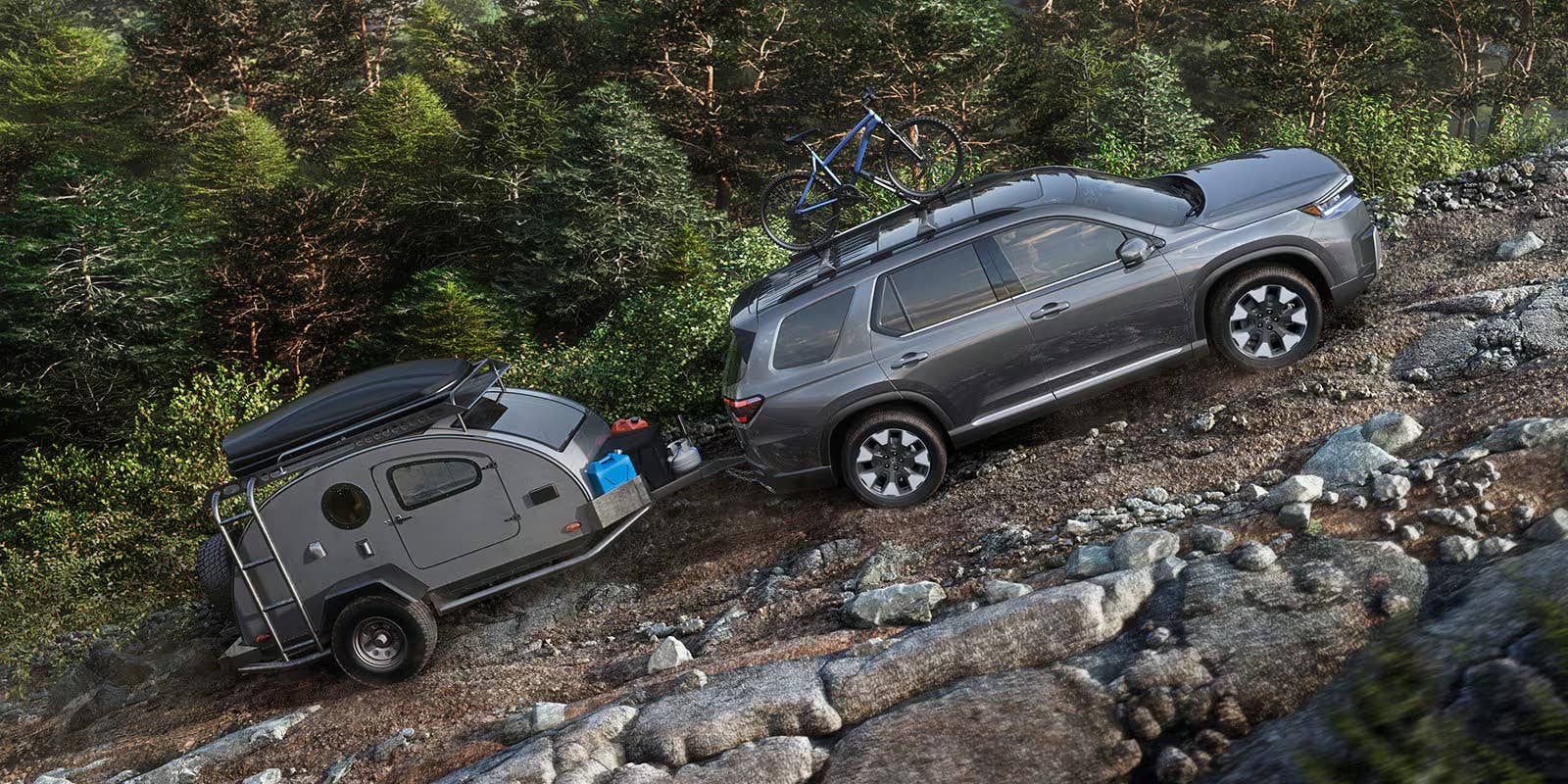
At the TrailSport level, the comparison becomes especially interesting. The Passport TrailSport costs $48,650. The Pilot TrailSport costs $50,395. The Passport TrailSport is $1,745 cheaper, has better off-road geometry, weighs less, and shares the same core engine, transmission, and AWD hardware. At the top end, the Pilot Black Edition reaches $54,995, while the Passport TrailSport Elite Blackout lists at $53,850.Verdict: Honda is not pricing these two SUVs by size alone. The Pilot charges for family capacity. The Passport charges for focus, packaging, and a more adventure-oriented brief.
4. Family Features Live In The Pilot, And They Don’t Migrate
The Pilot’s family advantage is not only its third row. CabinTalk, Honda’s in-car PA system that lets the driver speak to rear passengers through the back speakers, is standard on Pilot Touring trims and above. It sounds like a gimmick until you have spent 40 minutes on the highway asking whether anyone needs a bathroom stop.
The Pilot EX-L and above also adds a removable second-row middle seat, allowing the second row to switch between a bench and captain’s-chair-style layout without permanently giving up seating capacity. Third-row USB-C charging is also available. Passenger volume reaches as much as 158.4 cubic feet on Pilot Sport and EX-L trims, compared with 119.1 cubic feet in the Passport RTL and TrailSport.
The Passport has its own strengths, but they are different ones. The cargo floor is broad, the load area is less compromised, and the space behind the second row is easier to use because there is no third row folded into the floor. For regular cargo hauling, the Passport’s rear area is the more straightforward workspace. But the family-hauling features, by definition, require a family-hauling body, and the Passport does not have one.Verdict: If your week involves moving multiple children, grandparents, carpool passengers, or a rotating mix of people and luggage, the Pilot was designed for that job. The Passport was designed around a different kind of practicality.
Honda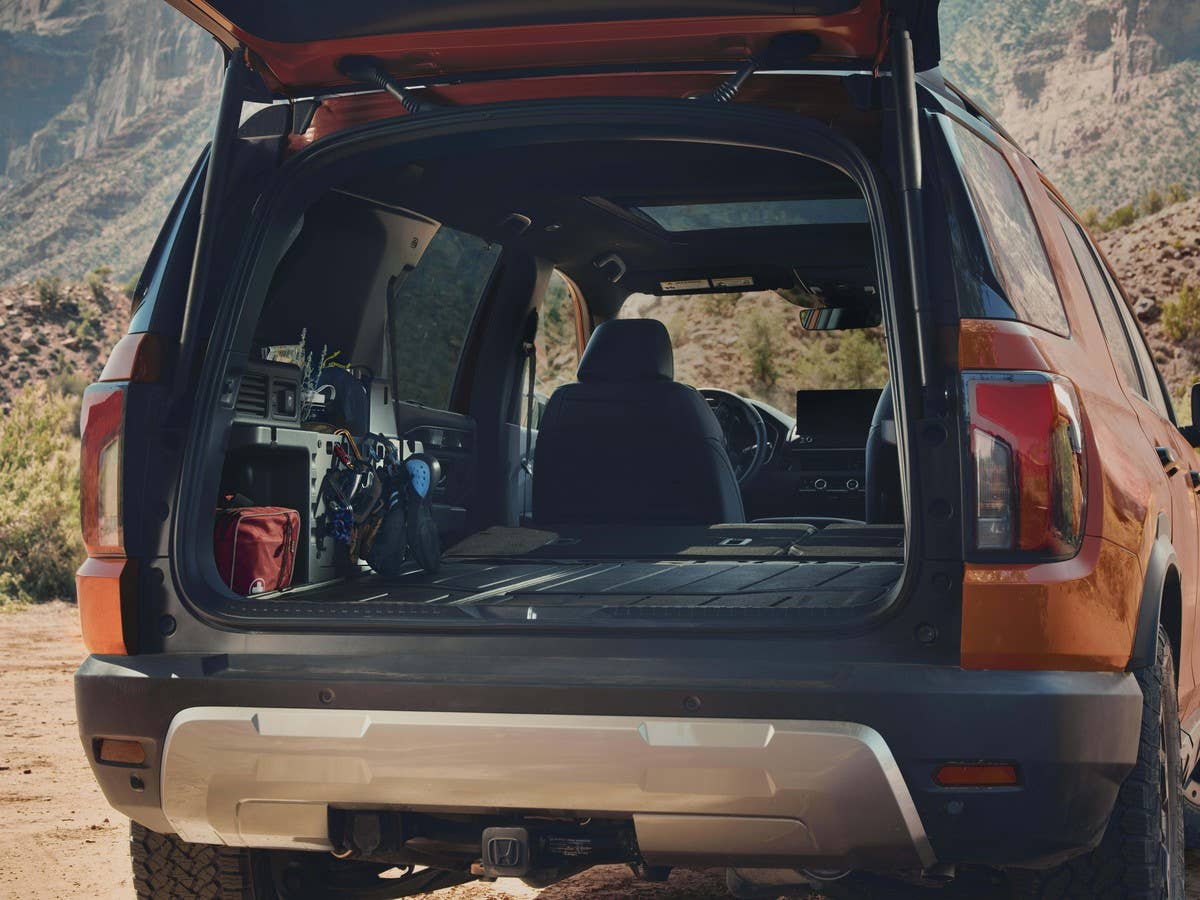
5. The Passport Is The More Manageable Vehicle In Daily Use
The Pilot is 200.1 inches long. The Passport is 191.5 inches long. That 8.6-inch difference is significant in daily use, especially because the wheelbases are nearly identical. The driver feels overall length, not just wheelbase, when parking in tight urban spaces, reversing out of angled driveways, or threading through a cramped parking garage.
The Passport is also taller, at 73.1 inches compared with the Pilot’s 71.0 inches, and its more upright shape gives it a clearer, more squared-off feel from behind the wheel. Less length, more glass, and easier corner placement make it the more manageable vehicle in tighter spaces.
Curb weight moves in the same direction. The Passport TrailSport weighs 4,676 pounds, while the Pilot TrailSport weighs 4,722 pounds. A 46-pound difference is small in isolation, but it supports the broader point: the Passport is the shorter, lighter, easier vehicle to place accurately.
That matters in the city, but it also matters on a trail. Misjudging a corner in a parking garage is annoying. Misjudging one near a rock, rut, or narrow forest track can be expensive.
Verdict: The Pilot is not an unwieldy SUV, but it is unambiguously the larger one. If parking, visibility, and easy placement matter, the Passport has the advantage.
Related: 2025 vs 2026 Honda Pilot: Is the New One Worth It?
Final Thoughts
The 2026 Honda Passport and 2026 Honda Pilot answer two genuinely different briefs, even though they share almost every major mechanical component. The right choice depends almost entirely on what your household looks like week to week.
If you need the third row, the Pilot is the clear answer. The most broadly compelling version is the EX-L AWD at $46,595. It adds the comfort and family features most buyers actually want, including leather-trimmed seating, a panoramic moonroof, wireless charging, and the removable second-row middle seat. It stops short of the Touring’s price escalation while delivering the core Pilot experience. For families, this is the rational center of the lineup.
If you do not need the third row, the Passport TrailSport at $48,650 is the more interesting SUV. It has better off-road geometry than the Pilot TrailSport, costs $1,745 less, weighs slightly less, and gives up little on-road for buyers who do not need eight seats. The Pilot TrailSport still makes sense for buyers who want three rows with some rugged-road capability, but that is a narrower brief than the badge suggests.
They’re not just big and small versions of the same SUV. The Pilot is the one for family life, with more seats and more space for everyone. The Passport is a little more personal, a two-row SUV that goes where you go. Pick the one that fits how you actually live.
Honda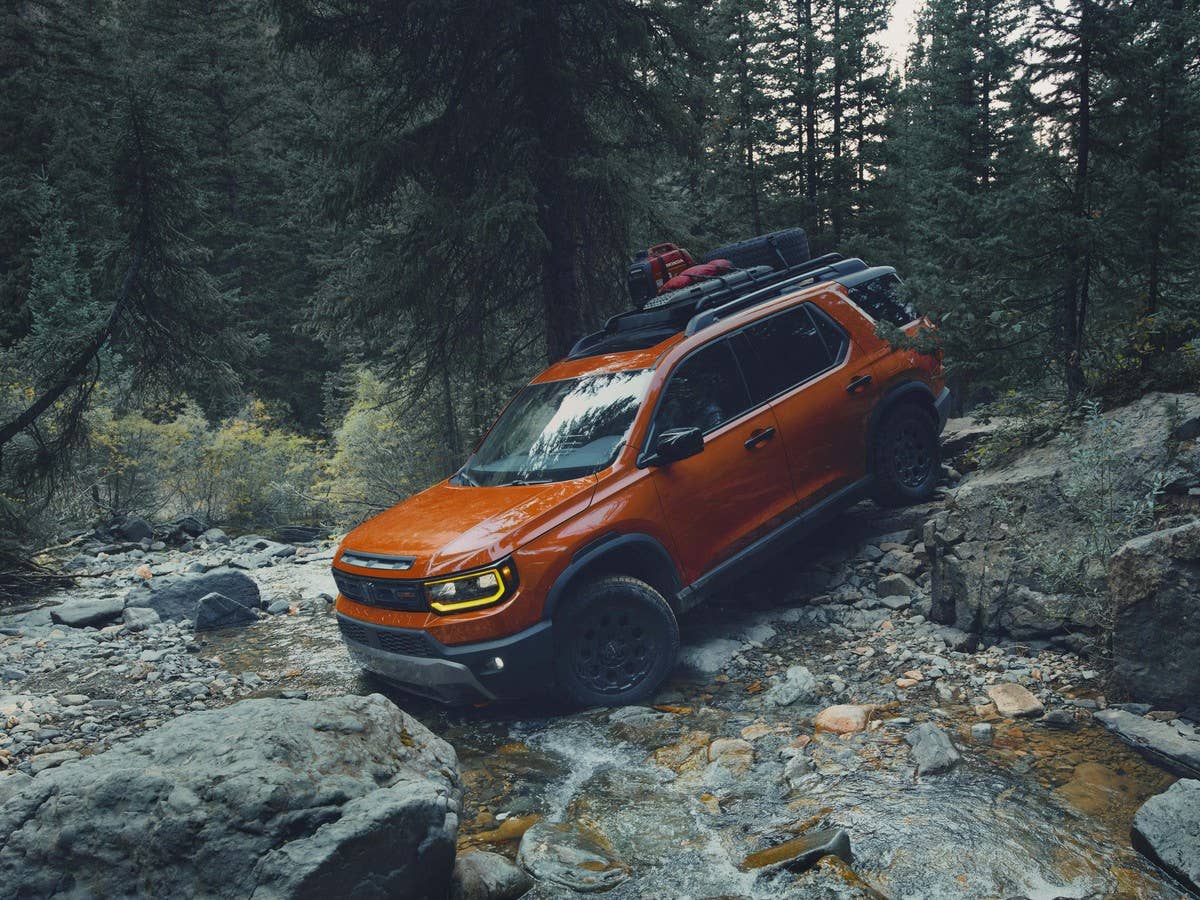
View the 2 images of this gallery on the
original article