

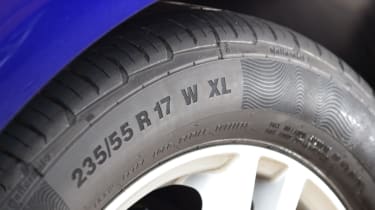
The following letter – W – is the tyre’s speed rating. You can find out more about speed ratings in the table below.
The final pair of digits – E4 – is an approval mark showing the tyre has been tested and approved by the European regulatory authorities. You should always check if your tyres carry this approval.
What is a tyre speed rating?
The tyre’s speed rating represents the top speed that the tyre is capable of maintaining and will be illustrated on your tyres sidewall with a single letter (see example above).
It’s essential that you choose a tyre capable of travelling at speeds in excess of your car’s maximum speed, even though every tyre is capable of maintaining speeds of more than 70mph.
If you fail to fit a compatible tyre with the correct speed rating, you could find your car insurance invalidated. Driving without valid car insurance could result in you being given a fixed penalty of £300 and six points on your licence should you be caught by the police.
How do I find the correct tyre speed rating for my car?
The tyre speed ratings for your car will be listed in your vehicle’s owner’s manual. Alternatively, check with your main dealer.
Tyre speed rating codes
| Speed rating | Top speed |
| N | 87mph |
| P | 93mph |
| Q | 99mph |
| R | 106mph |
| S | 112mph |
| T | 118mph |
| U | 124mph |
| H | 130mph |
| V | 149mph |
| Z | 150mph+ |
| W | 168mph |
| Y | 186mph |
EV tyre markings
Electric vehicle tyres will have very similar tyre codes to the example provided above, but you might see the letters ‘HL’ at the beginning of the tyre marking. HL indicates that the tyre is capable of handling a higher load index and is suitable for use on an electric car.
Run-flat tyres
Run-flat tyres allow you to drive for up to around 50 miles and a maximum of 50mph if there has been a loss of pressure or a puncture to your tyre. The code on run-flat tyres can vary between manufacturers, but will often be shown as RFT, EMT, ROF, ZP, DSST or SSR.
OE tyre markings
Some tyres are specifically designed for certain car manufacturers. OEM, or Original Equipment Manufacturer, tyre markings are labelled on many tyres to show which car brand a tyre was specifically engineered for. The following table shows which markings correspond to which manufacturers:
| Original Equipment Manufacturer | Sidewall Marking | Explanation |
| Alfa Romeo | AR | Alfa Romeo |
| Aston Martin | AM | Aston Martin |
| Audi | AO | AOE | RO1 | Audi Original | Audi Original Extended (ROF) | Audi Quattro |
| Bentley | B | Bentley |
| BMW | * | “Star” marking |
| BMW & Mercedes | * MO(E) | “Star” marking & Mercedes Original (Extended) |
| Ferrari | K1, K2, K3 | / |
| Jaguar | J | Jaguar |
| Lamborghini | L | Lamborghini |
| Land Rover | LR | Land Rover |
| Jaguar & Land Rover | JLR | Jaguar Land Rover |
| Lotus | LS | Lotus Exige S |
| Maserati | MGT | Maserati Genuine Tires |
| Maserati & Jaguar | MGT J | Maserati Genuine Tires & Jaguar |
| McLaren | MC | Mclaren |
| Mercedes | MOE | MO | MO1 | Mercedes Original Extended (ROF) | Mercedes Original | Mercedes Original (for AMG models) |
| Nissan | NR1 | Nissan GT-R Nismo |
| Porsche | N0, N1, N2, N3, N4, N5, N6 | |
| Tesla | T0, T1, T2,… | Tesla Original |
| Volvo | VOL | Volvo |
New car tyre labelling stickers
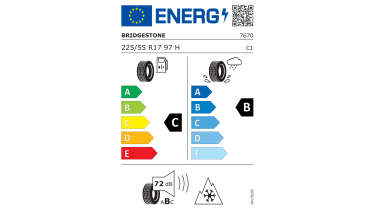
Every new tyre sold in Europe comes with a label that provides information on wet grip, the tyre’s rolling resistance and the noise it generates. An update in 2021 saw the fuel efficiency chart being updated to show overall rolling resistance, as well as the addition of icons for tyres which are suitable for use in severe snow and icy conditions.