

For the first time in recent measurement history, luxury automakers offer no customer satisfaction advantage over their mass-market counterparts.
Other key takeaways from the study include:
Mass-Market Nameplates
Toyota (83, up 1%) takes the industry lead. Toyota and Honda (80, down 1%) have also maintained broad sedan lineups while competitors have shifted to SUVs, offering lower transaction prices that give more buyers access to the new car market.
Subaru retreats 5% to 81, losing more ground than it gained last year. Ram (up 7% to 74), Kia (up 3% to 79), and Jeep (up 3% to 76) are the largest gainers in the segment.
Buick (down 16% to 68) posts the study’s largest decline. GMC (down 6% to 76) and Chevrolet (down 5% to 75) also fall as GM was hit harder by tariffs than many competitors.
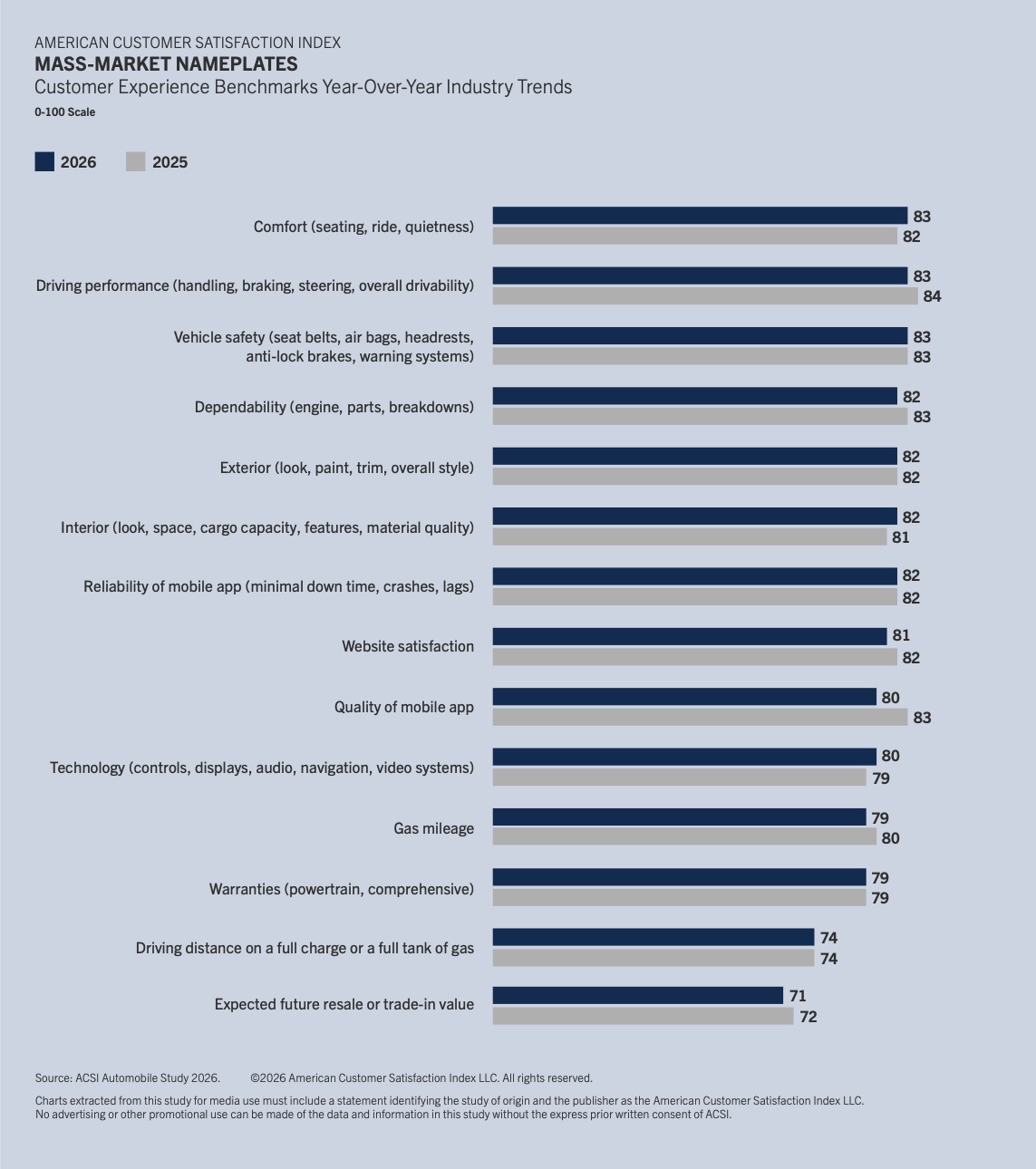
Technology (up 1% to 80), comfort (up 1% to 83), and interior (up 1% to 82) are the only customer experience metrics to improve. Mobile app quality posts the largest decline, dropping 4% to 80.
Mass-market complaint handling improves slightly (67), yet the top complaint areas are electrical/battery/software, service/dealer/customer support, and engine/powertrain.
Luxury Nameplates
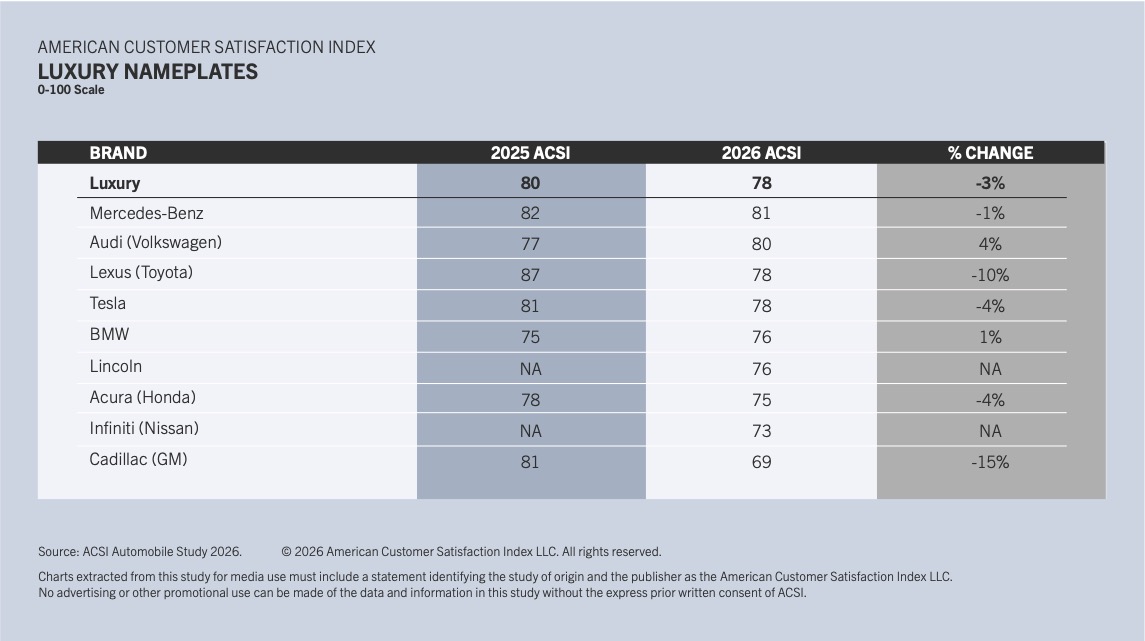
Mercedes-Benz (down 1% to 81) leads the segment. Audi surges 4% to 80, the largest luxury gain, after a 4% decline in 2025 that was largely attributed to EV frustration.
Lexus drops 10% to 78 after leading the entire industry a year ago. Lexus posted record U.S. sales of 370,260 vehicles in 2025 (up 7.1%), with electrified vehicles at 35.6% of sales. The luxury hybrid category overall declines 4%, which directly affects a brand with a heavy electrified mix.
Cadillac plunges 15% to 69, last in the luxury segment. Fourth-quarter 2025 U.S. sales declined 17% year over year, with EV sales falling 43% after the federal tax credit was eliminated. Tesla (78, down 4%) continues a two-year downward trend.
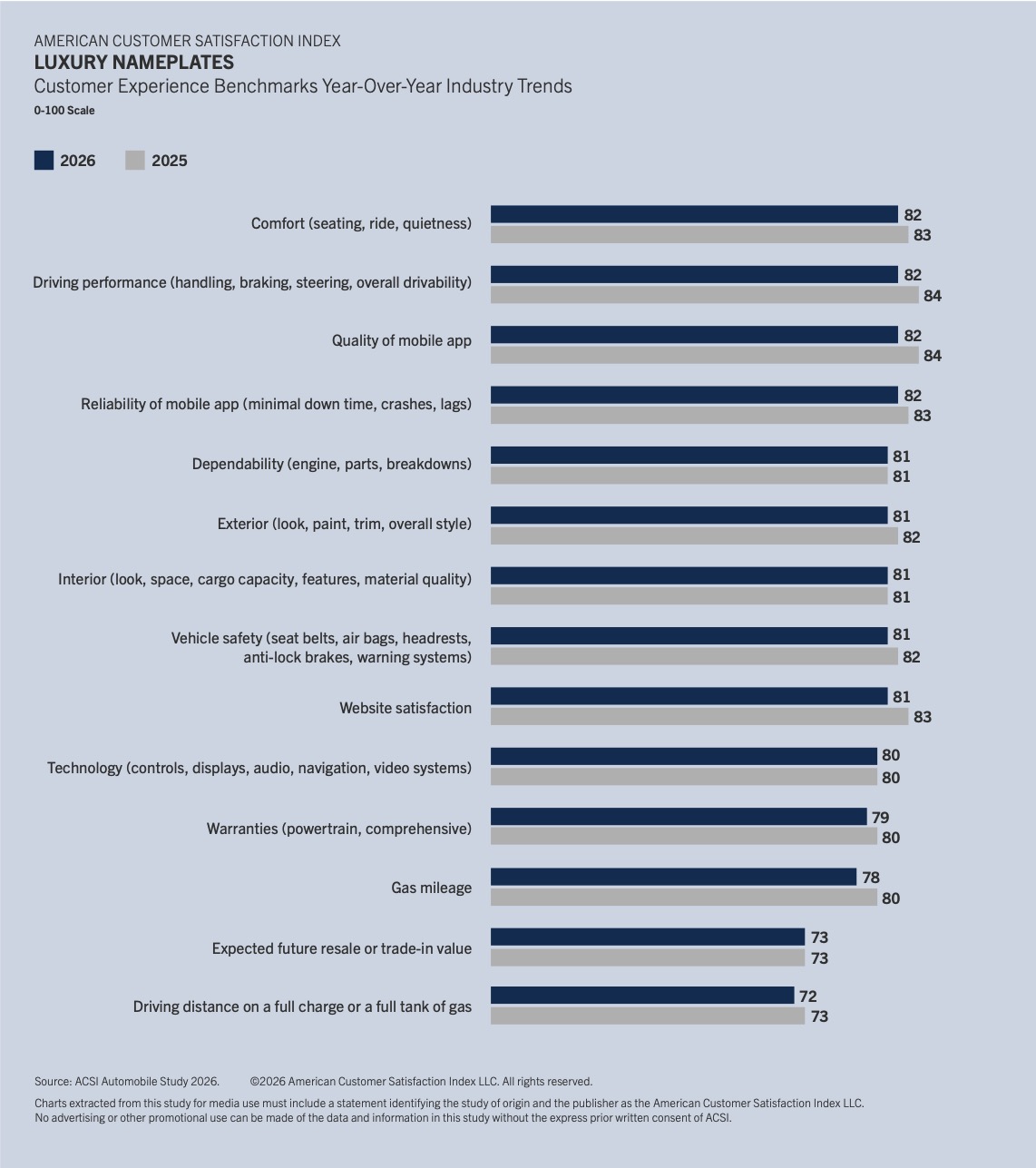
Every measured aspect of the luxury customer experience either declines or stays flat. Gas mileage posts the steepest decline (down 3% to 78), while driving performance (down 2% to 82) and mobile app quality (down 2% to 82) also fall. Luxury complaint rates jump 14% to 32%.
Luxury complaint handling deteriorates to 73 (down 4%). The top three complaint areas for luxury customers are service/dealer/customer support. electrical/battery/software, and engine/powertrain.
Vehicle Fuel Source
In the mass-market segment, ratings for driving distance and expected resale value differ widely by fuel source, and the two metrics track closely together. Hybrid customers rate driving distance highest at 76, followed by gasoline at 74 and EVs at 64. Resale value follows a nearly identical pattern: 75 for hybrids, 71 for gasoline, and 63 for EVs.
In the luxury segment, hybrid vehicles again score highest on both driving distance (74) and expected resale value (75), followed by gasoline (72 for both) and EVs (71 for both).
The ACSI Automobile Study 2026 is based on 6,699 completed surveys. Customers were chosen at random and contacted via email between July 2025 and June 2026.