

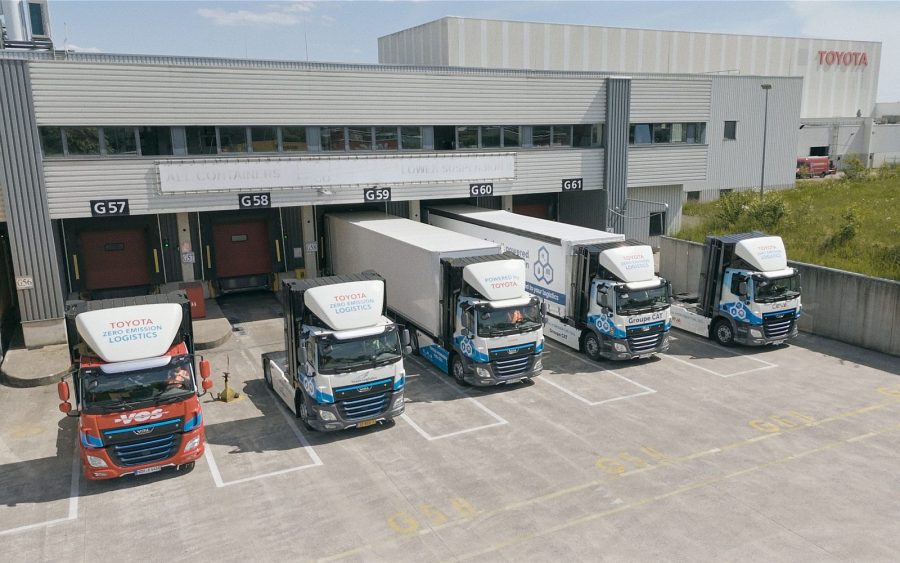
Toyota’s progress in the decarbonisation of operations took another significant leap forward with the launch of a fleet of heavy-duty hydrogen fuel cell trucks for our European logistics routes. These zero-emission* hydrogen trucks are being used to transport parts and accessories from our European parts centre in Diest, Belgium – including items that will ultimately be shipped to the UK.
The 40-tonne hydrogen trucks were built by VDL Groep in the Netherlands using Toyota fuel cell modules. Meanwhile, the project is additionally supported by Vos Transport Group, CEVA Logistics, Groupe CAR and Yusen Logistics in order to operate the trucks and evaluate their performance. Toyota’s operation in Diest currently processes more than half a million parts and accessories every day.
What makes a hydrogen truck better than diesel?
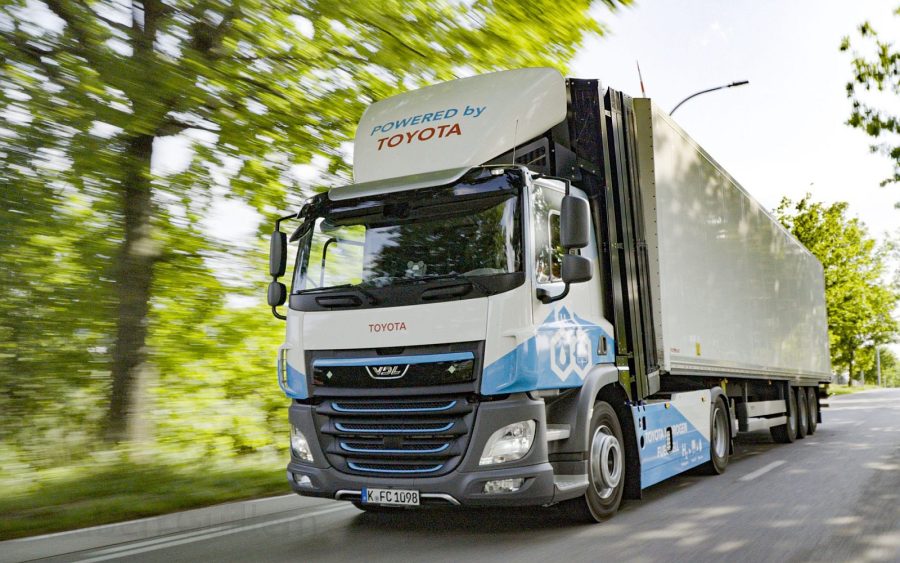
Performance of the hydrogen truck is similar to that of a diesel vehicle, however, it produces zero ‘tailpipe’ emissions. This is because its motor is powered by electricity generated by the electrolysis of hydrogen and oxygen within the fuel cell. On a single tank of hydrogen the truck can cover up to 250 miles in read-world driving conditions. In addition, the vibration-free rotation of its electric motor causes less noise and disturbance within local communities when the vehicle is running.
Thiebault Paquet of Toyota Motor Europe commented: “This initiative is in line with Toyota’s goal to reach carbon neutrality in its logistics operations by 2040. It also aims to help grow the hydrogen economy.
“Heavy-duty fuel cell trucks like these can boost the demand for hydrogen, along with the implementation of the European Union’s Alternative Fuel Infrastructure Regulation (AFIR). Together with our logistics providers, we want to gather learnings from operation of our first hydrogen-powered logistics fleet and further improve the vehicles and operating processes.”
Learn more: How does a hydrogen fuel cell work?
Learn more: How renewable energy is decarbonising marine transport
* In the context of this article, ‘zero emissions’ refers to no greenhouse gases or harmful particles being emitted by the powertrain while driving. While water is the only tailpipe emission, other emissions may still exist at other stages of the product lifecycle (extraction, manufacturing, logistics, maintenance, recycling/scrapping etc) but also during use (tyres, brakes etc) and the production of hydrogen, depending on its source.