

The quality of new vehicles has improved industry-wide year over year. According to the JD Power 2026 U.S. Initial Quality Study (IQS),SM released today, overall new-vehicle quality, as measured by the total number of problems per 100 vehicles (PP100) experienced in the first 90 days of ownership, has improved sharply this year, with fewer problems cited across nine of 10 categories evaluated. Infotainment is the exception, where connectivity issues continue to strain customer experience with new-vehicle quality. A lower PP100 score indicates higher vehicle quality.
“As more technology is introduced into vehicles, keeping the experience simple matters more than ever,” said Frank Hanley, senior director of auto benchmarking at JD Power. “The biggest gains in quality come from features that are easy to use—simple controls, less-intrusive driver assistance and software that works the way customers expect. When technology becomes too complicated, the likelihood of customers experiencing a problem rises considerably.”
Following are some key findings of the 2026 IQS:
Infotainment presents quality challenges: The only category experiencing an increase in reported problems this year is infotainment, with a total of 44.4 PP100 in the mass market segment and 38.3 PP100 in the premium segment. Within the infotainment category, problems with Android Auto and Apple CarPlay connectivity account for an increase of 1.4 PP100 in reported problems, the largest single contributor to the year-over-year decline in infotainment quality.
Touchscreens contribute to distracted driving: Among owners who detailed a distracted driving-related problem with their vehicle, 46% said the source of the distraction was from the infotainment or touchscreen, while 18% were distracted by driver assistance alerts.
The dataset is based on a battery of 227 VOC questions plus relevant repair data, all of which is organized into 10 vehicle categories: infotainment; features, controls and displays; exterior; driving assistance; interior; seats; powertrain; driving experience; climate; and unspecified (unique to repair). The dataset is designed to provide manufacturers with information to facilitate the identification of problems and to drive product improvement. The data was collected from June 2025 through May 2026.
Highest-Ranking Brands and Models
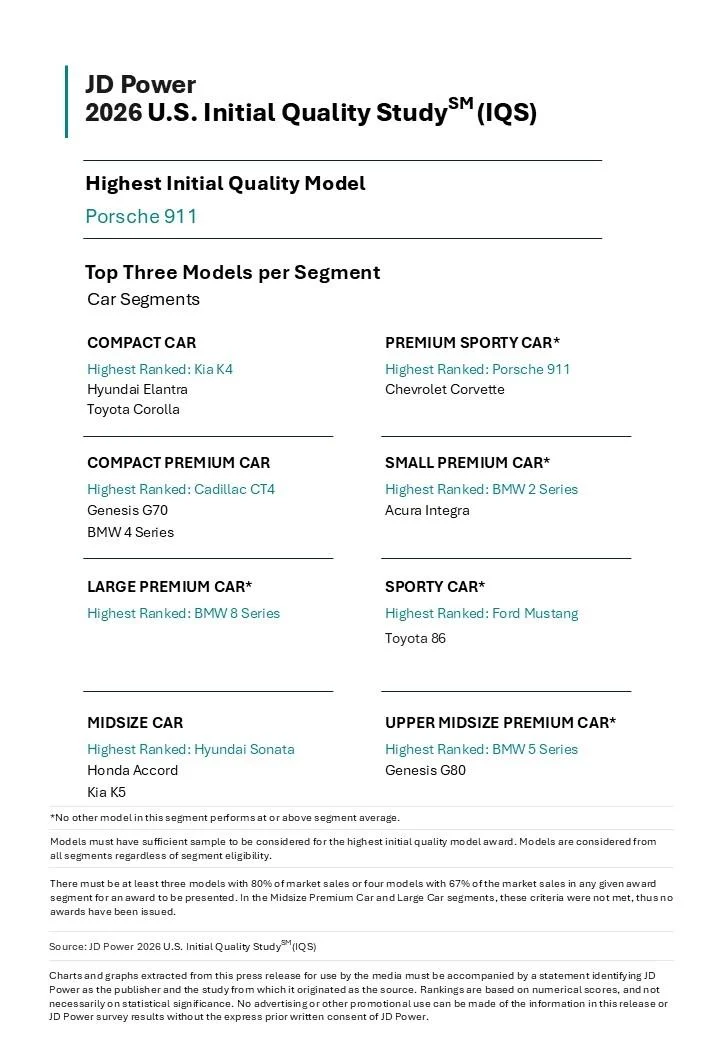
Porsche is the highest-ranking brand overall in initial quality with a score of 138 PP100. Among premium brands, Genesis (151 PP100) ranks second and Lexus (156 PP100) ranks third.
Among mass market brands, Ford ranks highest with a score of 152 PP100. Nissan (156 PP100) ranks second and Buick (162 PP100) ranks third.
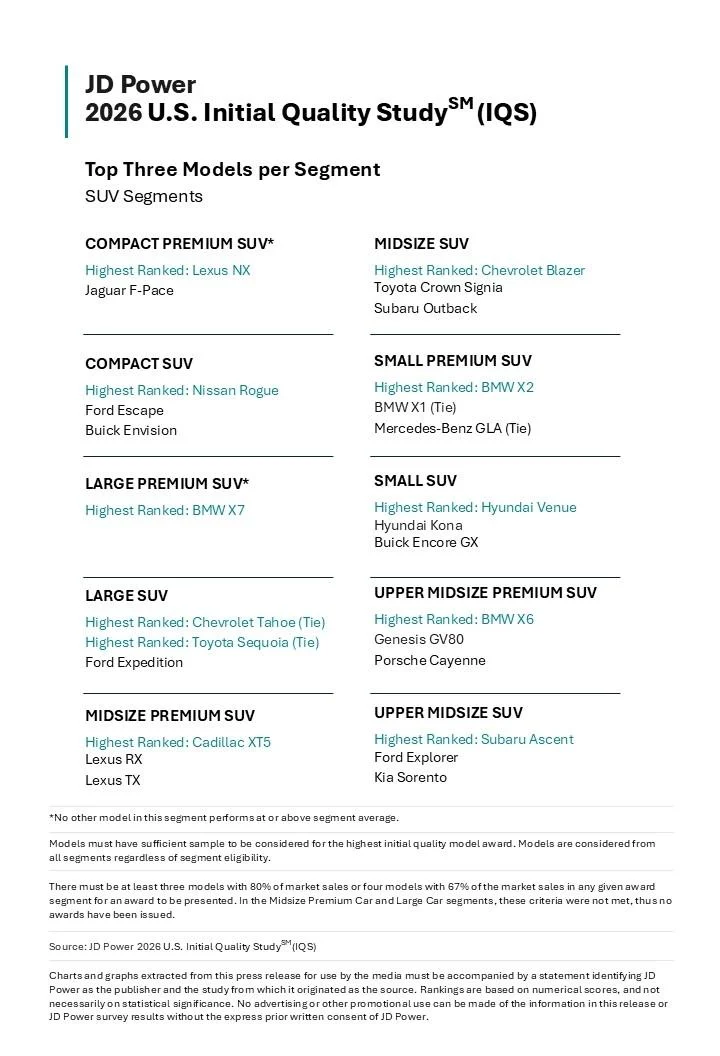
The parent corporation receiving the most model-level awards is BMW (six awards). Hyundai Motor Group (five awards) ranks second and General Motors Company (four awards) ranks third. Among brands, BMW receives the most segment awards (six). Ford and Hyundai rank second, in a tie, each with three segment awards.
BMW models that rank highest in their respective segment are BMW 2 Series, BMW 5 Series, BMW 8 Series, BMW X2, BMW X6 and BMW X7.
Hyundai Motor Group models that rank highest in their respective segment are Hyundai Santa Cruz, Hyundai Sonata, Hyundai Venue, Kia Carnival and Kia K4.
General Motors models that rank highest in their respective segment are Cadillac CT4, Cadillac XT5, Chevrolet Blazer and Chevrolet Tahoe.
Ford Motor Company models that rank highest in their respective segment are Ford F-150, Ford Mustang and Ford Super Duty.
Volkswagen AG has the highest-ranking model overall, the Porsche 911, with 110 PP100.
Plant Quality Awards
Toyota Motor Corporation’s Kyushu 1, Japan plant, which manufactures the Lexus NX and Lexus UX, receives the Platinum Plant Quality Award. Plant quality awards are based solely on defects and malfunctions and exclude design-related problems and repair incidents.
The Gold Plant Quality Award for North/South America goes to the Hyundai Motor Group’s Nuevo Leon KMX, Mexico plant, which produces the Kia K4. The Gold Plant Quality Awards for Europe and Africa, in a tie, go to Porsche AG’s Leipzig, Germany plant, which produces the Porsche Macan and Porsche Panamera, and the Posche AG Stuttgart, Germany plant, which produces the Porsche 911 and the Porsche Taycan.