

Toyota offers 1.8 and 2.0-litre hybrid setups, with 138bhp and a useful 193bhp respectively, the latter covering 0-62mph in 7.4 seconds. More importantly perhaps is economy: 64.1mpg for the 1.8, and 62.7mpg for the 2.0, in the base Icon spec (with the most efficiency-friendly wheel and tyre package). Another ace the Corolla has up its sleeve is an estate version, the Touring Sports, which is only a little less frugal and a little more expensive (starting at about £32,000, or £1,350 more than the hatch). It has up to 598 litres of boot space in 1.8-litre form.

“Thanks to great refinement, a comfortable ride, fantastic build quality and handling that’s precise and controlled – if not the last word in driving pleasure – there’s very little to dislike about the Corolla.” – Ellis Hyde, news reporter, who drove the Corolla in the UK
.
Latest Toyota Corolla deals
8. Volkswagen Golf eHybrid
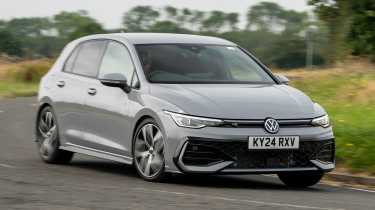
- Price from £36,280
- Best for EV range
| Pros | Cons |
| Vastly improved in-car tech | Some ergonomic niggles remain |
| Diverse powertrain range | Underwhelming cabin quality |
| Reassuring ride and handling | Road noise on larger wheels |
In the past if you wanted a fuel-efficient Volkswagen Golf, you probably bought a diesel. Due to err… fairly well-publicised events around a decade ago, VW adjusted its focus, and today plug-in cars are the main draw. Thus the Golf gets a plug-in hybrid model, and VW really hasn’t held back, as with up to 89 miles of pure EV range, few plug-in hybrids go further on a charge.
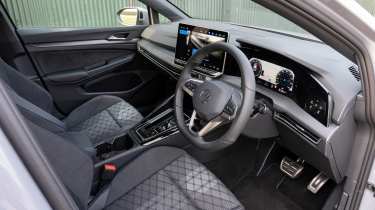
It’s significant for company users, as low CO2 and a long EV range put the Golf into just the 6% Benefit-in-Kind bracket. But for all Golf eHybrid drivers, you get WLTP economy of a barmy-sounding 1,000mpg. With a flat battery you can expect something more in the 50s and 60s, but the long EV range means the eHybrid is the de facto e-Golf. There’s even a sporty one: a 268bhp Golf GTE, which itself has 82 miles of EV range.