

Most settings are buried in a sub-menu of the driver’s display, and are labelled by abbreviations that aren’t that clear or easy to understand. Some rivals make disabling these systems easier than in the Prius.
Taking a more stylish approach with the Prius is an interesting strategy for Toyota. It’s a name that has long been associated with eco-conscious buyers, and slow and steady performance in the name of fuel efficiency.
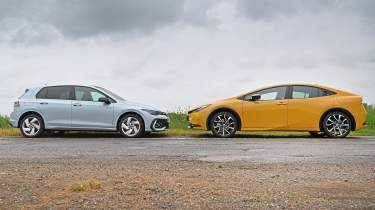
Now, the latest model has taken a radical turn; yes, low energy usage is still very much a core part of the Prius’s make-up, but it’s also trying to appeal to more style-driven buyers – and even keen drivers, too. The question is, does the Prius name have the prestige to carry off its new position?
Head-to-head
On the road
Toyota has judged the Prius’s chassis superbly, with a more compliant low-speed ride than the Golf, but with great body control on a twisty road. It’s fun, but still impressively refined. The Golf’s powertrain offers similar outright performance, but isn’t as smooth. However, its optional adaptive dampers are brilliant; the high-speed ride is great in their softest settings and the chassis is sharp in firmer positions.
Tech highlights
The GTE’s 19.7kWh battery is enough to see it officially cover 81 miles on electric power. Combined with a 108bhp motor and a 1.5-litre turbo petrol engine, there’s 268bhp. The Toyota’s 149bhp Atkinson- cycle engine is designed for efficiency, and the 161bhp e-motor offers more grunt; combined, they make 220bhp. At 13.6kWh, its battery is smaller, but it still returns a WLTP electric range of 44 miles.
Price and running
THE GTE’s long EV range puts it into the six per cent tax band for company cars. That’s three per cent lower than the Prius, which is the difference between annual deductions of £480 a year for the Golf and £727 for the Toyota for a standard-rate income-tax payer. Charge the VW regularly at home and it will be cheap to run, but the Prius is much more fuel-efficient once the batteries have been depleted.
Practicality
The plug-in hybrid powertrain compromises the Golf’s boot space compared with other non-hybrid Golfs; capacity drops from 381 litres to 273 litres. But the cabin is as spacious as ever. The Toyota’s coupé-like profile harms its usability; the roofline makes access awkward in the front, and rear headroom is tight. Yet kneeroom is better than in the Golf, and the 284-litre boot is 11 litres larger than its rival’s.
Safety
Euro NCAP awarded the Golf family five stars when it was tested in 2022. While the standards have increased since then, so has the VW’s standard safety kit; the GTE gets adaptive cruise control, lane assist, a reversing camera and all-round parking sensors. The Prius hasn’t been tested by NCAP; the closest car that has is the Toyota C-HR – the pair share a platform and powertrain – and it earned five stars.
Ownership
Volkswagen finished 28th out of 32 brands in our 2024 Driver Power satisfaction survey, with disappointing marks for reliability and quality. Toyota didn’t quite hit the heights of previous years, but an eighth-place finish remains a strong result. The brand offers up to 10 years’ warranty cover, as long as annual services are carried out at an approved dealer. The Golf gets a less impressive three-year package.
Verdict
Winner: Toyota Prius
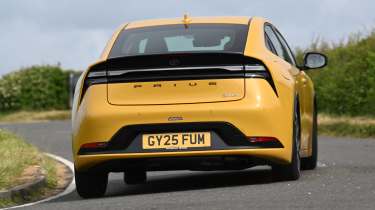
The Prius has become more desirable than ever before, but more importantly, it’s better to drive, too. The ride and handling are great, and thanks to its powerful PHEV powertrain, the car has got the performance to match its chassis where its predecessors didn’t.